
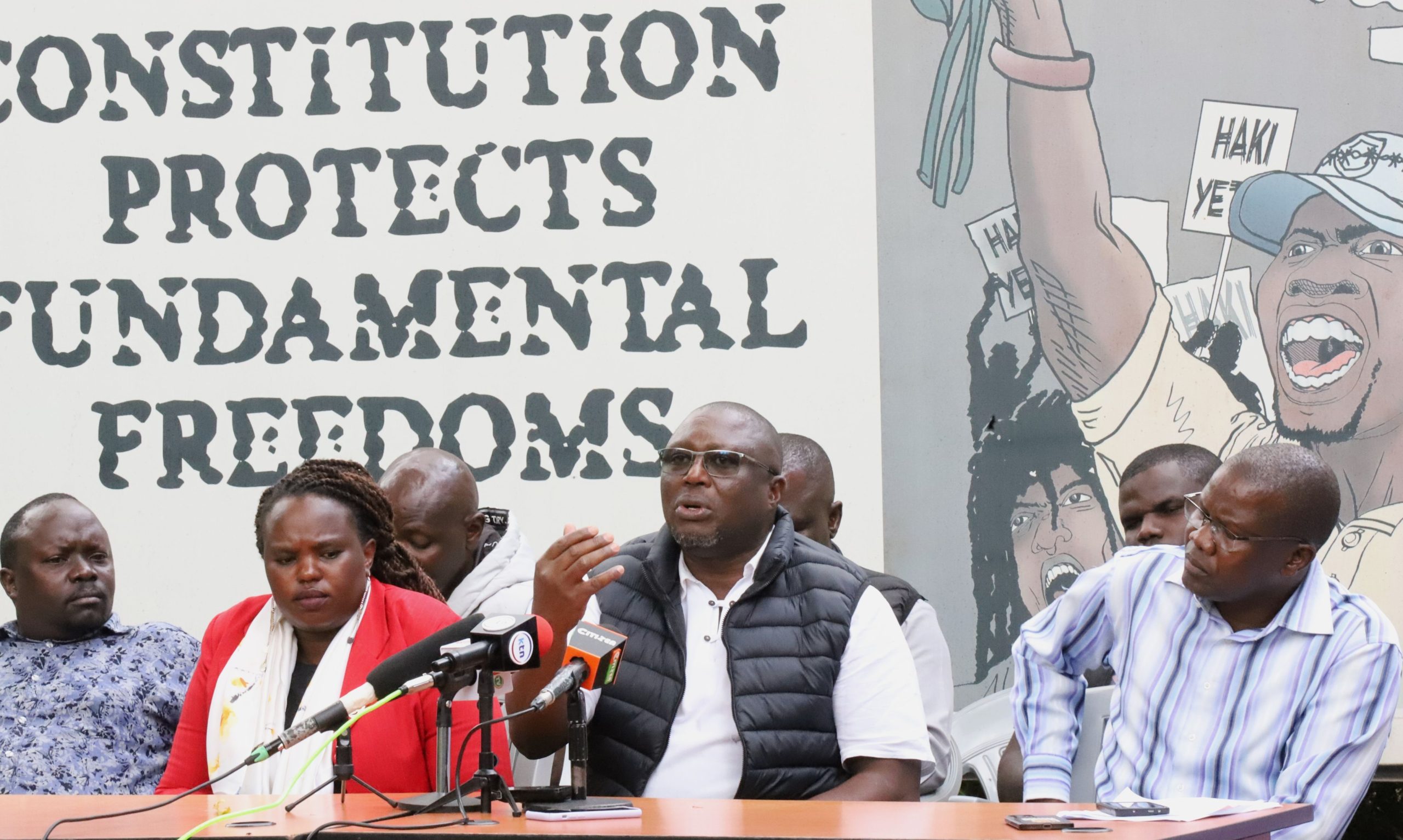
We are heartbroken and angered by the killings of Henry Otieno and Jack Omenda in Gem-Ramula, Siaya, on April 6, 2026. We are also troubled by ongoing police harassment and intimidation of local residents. These deaths followed a confrontation between community members and police officers connected to mining activities involving Shanta Gold Limited.
Shanta Gold has explored gold in Ramula–Mwibona and the wider western region for several years. When the company announced in 2022 that it had found commercially viable gold, it caused fear, division, and tension in the community. Since then, the company’s operations have lacked transparency, shared little information, and involved few community members, leading to mistrust and anxiety about the project.
Despite these concerns, the company has continued its activities with state protection, including police sent against unarmed residents seeking accountability. The company’s actions and strong state support raise serious questions about who backs Shanta Gold in Kenya and whose interests are protected.
The company’s apparent impunity suggests it has powerful supporters and acts as if above the law. This protection encourages disregard for legal processes and accountability, harming community rights and the rule of law. Guided by the constitution and international human rights standards, we address the following critical issues.
1. Excessive use of force and extrajudicial killings
The events leading to these deaths are troubling. Community members held a peaceful protest to raise concerns about land rights, lack of consent, and transparency in local mining activities. Instead of listening or calming the situation, police responded with violence, even using live ammunition against unarmed people.
This was a clear and unjustified use of excessive force that led to two deaths. There is no excuse for using lethal force against unarmed citizens exercising their constitutional rights. These actions show a growing pattern of repression around Shanta Gold’s operations, where communities face threats, intimidation, and pressure.
We are also troubled by efforts from the Officer Commanding Police Division (OCPD) Yala, Charles Wafula, to misrepresent these events to the public. Trying to distort the facts in such serious cases is unacceptable and only protects those responsible. We call for full transparency and an immediate, independent investigation into the police’s actions.
2. Harassment and intimidation by police and state agencies
We have received reliable reports of ongoing harassment by officers from the Directorate of Criminal Investigations (DCI). This includes the arrest of a woman and her three sons in ways the community describes as distressing and inhumane. The pressure, fear, and harassment linked to these actions reportedly contributed to the death by suicide of one of the sons.
We are especially concerned about the Ministry of Interior’s heavy involvement in what should be a civilian and regulatory issue handled by the Ministry of Mining and Blue Economy. Turning this process into a security matter is unlawful and inappropriate.
We have also seen cases of arbitrary arrests and what appear to be false or minor charges. These actions have forced families into serious financial hardship, even making them sell livestock to pay high bail. Such practices are oppressive and show a pattern of using the justice system to silence dissent.
We call out the Office of the Director of Public Prosecutions (ODPP) for not acting independently or objectively. Maintaining charges from questionable arrests raises serious concerns about complicity, abuse of process, and loss of public trust in the justice system. The ODPP should not allow itself to be used to legitimize repression.
3. Contempt of court orders
Even more worrying is the open disregard for the rule of law. There is a valid court order from the Siaya Law Courts in ELCLPET/E002/2025 stopping Shanta Gold from moving forward with resettlement and compensation. Yet, despite this order, operations continue, and state agencies are not enforcing the law.
This is a direct attack on the authority of the courts and the foundations of our constitutional principles. Ignoring court orders in this way raises serious questions about the integrity of our institutions and whether some people act above the law.
4. Disregard for regulatory compliance and due process
It is troubling how regulatory processes have been managed. The Environmental and Social Impact Assessment (ESIA) for this project did not include a resettlement action plan, though displacement was likely. Stakeholders pointed out this major flaw and formally objected, but licenses were still issued. Shanta Gold also did not share details about compensation, leaving the community in the dark until the Siaya County Commissioner recently mentioned relocating over 1,200 homesteads and showed houses being built by the company. These issues reveal a deeper failure and suggest the Ministry of Mining and Blue Economy and other regulators are not complying with the Mining Act, 2016, which requires genuine community involvement, proper land access, informed consent, and protection of community interests.
What is happening also goes against Kenya’s commitments under international human rights law. The UN Guiding Principles on Business and Human Rights say the state must protect people from abuses, and companies must respect those rights. Free, prior, and informed consent ensures communities can make their own choices and are not forced, misled, or left out of important decisions. In Ramula, people have repeatedly questioned how consent was obtained, but their concerns have been ignored.
5. The questionable involvement and inaction of state officers in Shanta Gold’s affairs
The OCPD in Yala is responsible for officers under his command, including the use of lethal force and misrepresenting events. The DCI must answer for ongoing harassment, intimidation, and arbitrary arrests by officers in Ramula and Mwibona. The County Commissioner, as the national government’s representative, should protect citizens, not allow fear and coercion. The National Land Commission (NLC) is supposed to manage public land, oversee land acquisition, and protect communities from forced displacement. Its absence in this conflict over land rights and resettlement is troubling and cannot be excused.
6. The role of the State Department of Mining in protecting community rights
We are also concerned about the April 7, 2026, statement from the Principal Secretary for Mining, Harry Kimtai, who said the Ministry plans to issue a license to Shanta Gold in Ikolomani, even though serious human rights issues in Ramula remain unresolved. The announcement felt casual and dismissive, showing little understanding of the situation’s seriousness. The ministry should not appear to support an investor while communities still have real concerns about consent, land rights, and ongoing violations.
In 2025, during the National Jukwaa la Madini meeting, community members met the Principal Secretary in his office, shared their challenges, and formally invited him to visit Ramula. He agreed, but this promise has not been kept, even after lives were lost. Instead, the ministry has held important meetings in Kisumu, far from the affected community. This raises serious questions about whether these processes meet the constitutional requirement for real public participation under Article 10 and the Mining Act, 2016, which calls for identifying and involving affected communities. It also raises doubts about why meetings are not held openly with the actual community and whether these processes are just formalities to approve decisions already made.
The ministry has acted quickly in other situations, but its absence in Ramula at this crucial time raises an important question: Are all lives valued equally, or is the state’s response influenced by other factors? We stress that engaging with communities cannot be done from boardrooms or hotels. When rights, land, and livelihoods are at risk, the law requires the state to go to the people, not expect the people to come to them.
7. The failure of county leadership to act as the voice of the community
We recognize that mining is not a devolved function under the constitution, but we are deeply concerned by the ongoing silence and inaction of the County Government of Siaya, including the governor, County Assembly, senator, area MP, and MCA. These leaders were elected to protect the interests of Ramula’s people. Their absence at this critical time is obvious and unacceptable.
We are especially worried about parts of the county leadership who have long supported the company. The governor’s recent change in stance raises more doubts than trust. If leaders had acted sooner and more firmly, the situation might not have reached the point where lives were lost. We have also learned that the County Government gave the company a “no objection” letter, which urgently needs to be explained and accounted for.
The area MP and MCA have also supported the company, and the senator’s silence during these serious events is troubling. This failure of leadership has left the community exposed, unheard, and unprotected.
We especially call on the governor, as a senior counsel and a leader who knows constitutional and international human rights law, to step up and show principled leadership. This role comes with a greater duty to uphold the law, defend citizens’ rights, and speak clearly against violations.
8. Corporate responsibility to respect
Shanta Gold must immediately take responsibility for the human rights risks and harm caused by its operations in Ramula. Continuing to operate amid violence, intimidation, disputed consent, and ignoring legal processes breaches Kenyan law and international standards, including the UN Guiding Principles on Business and Human Rights. A company cannot claim to be uninvolved when its actions are directly linked to repression and harm against local communities.
We want to make it clear to Shanta Gold, its financiers, and business partners that we will use every available option to seek accountability. This includes starting proceedings with regional and international human rights bodies, such as the African human rights system, and filing formal complaints under international business conduct rules. We will also work with others in the company’s gold supply chain, like refiners, buyers, and financial institutions, to ensure any gold linked to human rights abuses in Ramula is closely examined and kept out of responsible markets. What is happening in Ramula puts Shanta Gold at serious legal, reputational, and business risk, and we will take further action to demand accountability if needed.
Demands
In light of these accounts, we demand that:
1. All mining-related activities by Shanta Gold in Ramula and across the Nyanza region must be immediately suspended until there is full compliance with the law, including the development of a credible resettlement action plan and the conduct of genuine, community-centred consultations in line with free, prior and informed consent.
2. All officers who discharged live ammunition against peaceful protesters must be immediately identified, investigated, and prosecuted, together with their commanding officers. Command responsibility must be enforced without exception.
3. The Independent Policing Oversight Authority (IPOA) must undertake a swift, transparent, and public investigation into the killings in Ramula, as well as the broader pattern of policing and use of force in the area.
4. The Kenya National Commission on Human Rights (KNCHR) must urgently initiate independent investigations to determine the extent of injustices, document violations, and pursue appropriate accountability and redress for affected communities.
5. The County Commissioner, the Sub-County Criminal Investigations Officer Yala, the OCPD Yala, and all officers directly or indirectly implicated must step aside immediately to allow for independent and impartial investigations.
6. The State Department for Mining must be urgently summoned by Parliament to publicly account for and disclose the legal and procedural basis upon which licenses were issued and operations allowed to proceed in the face of clear objections, legal concerns, and procedural irregularities.
7. NLC must urgently intervene to assess the legality of land acquisition processes, safeguard community land rights, and halt any actions that may lead to unlawful displacement.
8. ODPP must be held accountable for the institution and continuation of punitive and frivolous charges against protesters. The use of the criminal justice system to intimidate, harass, and silence citizens is an abuse of prosecutorial power and must cease immediately.
Signed
Haki Madini Kenya Coalition | Kenya Human Rights Commission (KHRC) | Kenya National Commission on Human Rights (KNCHR) | Inuka Kenya Ni SiSi | Twajibike Platform | Community Action for Nature Conservation (Canco) | Community Initiative Action Group | Independent Medico-Legal Unit (IMLU) | Defenders Coalition | Usalama Reforms Forum | Transparency International Kenya | Catalyste | Ramula Community Members | Geomine Consulting Group | Article 19 | Kenya Oil and Gas working group